
If you’re on the journey to better hearing, you’ve likely heard of the Pure Tone Audiometry (PTA) Test. It’s the critical first step, the bedrock of any successful hearing aid fitting. Yet, for many cost-conscious individuals, the thought of an unknown diagnostic fee creates an unnecessary barrier, prompting a search for clarity on the Pure Tone Audiometry Test price.
We understand that transparency is the key to building trust. You deserve clear, upfront pricing for professional, value-driven diagnostic services before committing to a hearing aid purchase. That’s why we’re demystifying the cost of this essential diagnostic procedure and highlighting the unparalleled long-term value of a precise diagnosis.
Pure Tone Audiometry (PTA) is the gold standard method used by audiologists worldwide to measure hearing sensitivity. It precisely determines the softest sound levels, the thresholds at which a person can hear a variety of frequencies (pitches).
The “pure tone” refers to the specific, single-frequency beeps you will be asked to listen to. The results of this test are charted on a graph called an audiogram, which provides a detailed map of your hearing ability, identifying the exact nature and degree of any hearing loss. This information is crucial for accurately diagnosing hearing health and recommending the best solutions, if necessary.
Your comfort and clarity are our priorities. When you choose an Aura Hearing Aid clinic, you are not just walking into a testing facility; you are meeting certified, experienced audiologists dedicated to ethical, compassionate care.
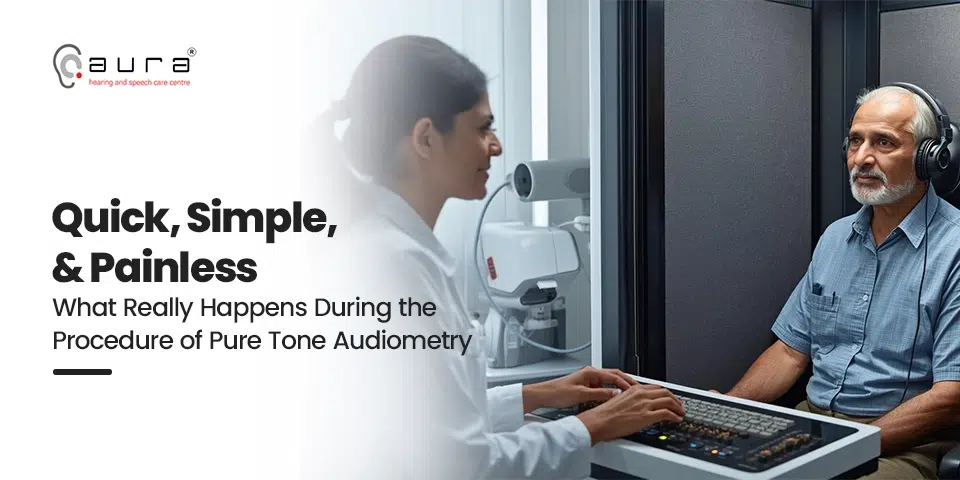
Our audiologists are highly trained professionals who specialise in making the process as seamless and stress-free as possible. They will walk you through every stage, ensuring you understand exactly what to do. Our clinics utilise state-of-the-art equipment, often housed within specialised, sound-treated booths, which ensures that the results we obtain are accurate, reliable, and form the best foundation for your path to better hearing.
The entire test typically takes less than 30 minutes. Below is a detailed breakdown of what you can expect during the hearing test.
Before the actual testing begins, your Aura audiologist will conduct a thorough initial consultation. This is a critical stage where you get to meet your professional and share your story.
✅ Filling out Forms: You’ll complete a brief questionnaire detailing your medical history, any noise exposure, and your specific hearing difficulties (e.g., trouble hearing in noisy restaurants, needing to turn up the TV).
✅ Visual Examination (Otoscopy): The audiologist will use a tool called an otoscope to look inside your ears. This is a quick, painless check to ensure the ear canal is clear of any obstructions (like excessive wax) and that the eardrum looks healthy. A clear canal is essential for an accurate test.
✅ Instruction Time: Your audiologist will explain the procedure of PTA test clearly. They will show you the response button and explain the cardinal rule: press the button every time you hear a tone, no matter how faint or soft it is. If you merely suspect you heard something, press it!
You will be escorted into a small, sound-treated room or booth. Many first-time patients worry that this space will feel restrictive or claustrophobic. In reality, these booths are designed to be comfortable and spacious enough to ensure complete acoustic isolation. The purpose is not confinement, but quietude, which blocks out all external noise (traffic, air conditioning, people talking), allowing your audiologist to test your hearing thresholds with perfect precision.
✅ Headphones or Insert Earphones: Your audiologist will fit you with either traditional over-the-ear headphones or small foam earpieces that sit just inside the ear canal (insert earphones). In-ear headphones are often preferred as they offer superior sound isolation and comfort.
✅ Microphone Check: Your audiologist will confirm that you can hear them through a microphone system and that you are ready to begin.
This is the primary part of the test. It evaluates how sound waves travel through the outer and middle ear to reach the inner ear—the natural pathway of hearing.
✅ The Process: The audiologist will present a series of pure tones (simple beeps) to one ear at a time. They start at a pitch (frequency) and volume they know you can hear, like a moderate tone at 1000 Hertz (Hz, or cycles per second, similar to the pitch of a telephone dial tone).
✅ The Descent Method: They will then systematically lower the volume in small steps (typically 10 decibels or dB) until you stop responding.
✅ The Ascent Method: Then, they will slowly increase the volume in 5 dB steps until you indicate you can hear it again. This process is called bracketing. The softest level at which you correctly hear the tone at least 50% of the time is recorded as your hearing threshold for that frequency.
✅ Testing Frequencies: This careful bracketing process is repeated across a standard range of frequencies (250 Hz, 500 Hz, 1000 Hz, 2000 Hz, 4000 Hz, and 8000 Hz) to cover the range of speech and important environmental sounds.
Remember, the audiologist is not testing your intelligence or concentration; they are measuring the absolute quietest sound your ear can perceive. Do not wait for a loud sound—if you barely hear a faint whisper of a beep, press the button!



For a complete procedure of PTA Test, the audiologist may also conduct bone conduction testing.
✅ What it is: This tests the hearing ability of the inner ear (cochlea) directly, bypassing the outer and middle ear structures.
✅ The Setup: A small device, called a bone conductor, is placed directly on the mastoid bone (the small bump behind your ear) or occasionally on the forehead. This conductor sends sound vibrations directly to the cochlea.
✅ The Sensation: You will still hear a beep, but you may also feel a slight vibration. You respond in the exact same way as before—by pressing the button the instant you perceive the tone.
✅ The Importance: Comparing the results of air conduction (through headphones) and bone conduction (through the vibrator) allows the audiologist to determine where a hearing problem lies: in the outer/middle ear (conductive loss) or in the inner ear (sensorineural loss).
Once the procedure is complete, you will return to the consultation room. Your Aura audiologist will present the audiogram, the graph that visually represents your hearing thresholds. They will patiently explain what the lines and symbols mean and discuss any findings in an easy-to-understand manner. This detailed review ensures you leave with a clear understanding of your hearing health and the recommended next steps.
Facing a hearing test doesn’t have to be intimidating. At Aura Hearing Care, our goal is to provide a comprehensive, quick, and comfortable experience supported by genuine professionalism. The PTA test procedure is your pathway to clarity, and our audiologists are ready to guide you confidently through it.
If you suspect hearing loss, or if it’s just time for a routine check, step into one of our welcoming clinics. You’ll be treated with respect, care, and the highest standard of audiological expertise. Don’t let anxiety delay your hearing journey.
Aura Hearing Care provides comprehensive audiological services, including Pure Tone Audiometry, at numerous centres across India:
📍Mumbai, Navi Mumbai, & Thane Region
No. The procedure of pure tone audiometry is completely painless and non-invasive, involving only listening to soft sounds through headphones.
The test typically takes 20 to 30 minutes, including consultation and explanation of results.
That is normal. You should respond whenever you think you hear a sound, even if you are unsure, as the goal is to find the quietest sound you can detect.
Yes. Each ear is tested separately, which helps identify hearing loss in one ear or differences between both ears.
You should consider this test if you have difficulty hearing conversations, experience ringing in the ears, or want a routine hearing health check.

Aura Hearing Care is a leading hearing aid provider offering personalized solutions with cutting-edge technology and expert care across India.
WhatsApp us